




History of Artificial Intelligence: Today, when we interact with AI platforms like ChatGPT or Gemini, it feels as if we are living in a science-fiction future. But did you know that the human desire to create an intelligent companion is not a modern miracle, but a scientific and philosophical quest spanning thousands of years?
It is often said that necessity is the mother of invention. However, in the grander tapestry of human history, imagination is the womb in which science is conceived. The trajectory of human progress is a cycle: we feel a need, we imagine a solution, and science brings that imagination to life. Today, we stand at a pivotal moment in this journey.
We have transitioned from basic automation to the threshold of Artificial General Intelligence (AGI), and the whispers of a looming Artificial Super Intelligence (ASI) suggest that our evolution is accelerating at an unprecedented pace.
To the casual observer, this explosion of knowledge might seem like a phenomenon of the last century. But this is a misconception. The foundations of modern science are etched into the stone and steel of civilizations thousands of years old. Since our inception, the human drive has remained constant: the pursuit of power, the optimization of resources, and the enhancement of welfare.
Whether it was the mastery of metallurgy for the first farming tools or the engineering of sophisticated weaponry for tribal dominance, our ancient aspirations mirror our modern ones. The struggle for survival and the quest for supremacy have always been the twin engines of innovation.
Let’s turn back the clock and explore how the ‘digital seeds’ of today were sown in the fertile minds of our ancestors.”
Imagination: The Unique Miracle of Human Evolution
After millions of years of evolutionary processes, humans emerged as Homo sapiens. Around 30 million years ago, our ancestors were part of the primate lineage, but nature performed a revolutionary experiment—the extraordinary development of our Prefrontal Cortex.
This biological evolution granted us a power unique among all creatures on Earth: The Power of Imagination.
This imagination became the bedrock of our astonishing scientific progress. Humans dreamed the impossible, and science paved the path to realizing it. Whether it was the desire to reach the stars or the quest for immortality, being a ‘dreamer’ fueled civilization.
Today’s Artificial Intelligence is the most refined form of this eternal dream, with roots deeply embedded in our ancient mythological sagas.
The Ramayana Era: Ancient India’s ‘Smart’ Technology
As per tradition, Circa 7,000 years ago
The Ramayana is not just a religious text but a grand epic of ancient Indian civilization that remains incredibly popular even today. It reflects a society that was deeply philosophical yet technologically imaginative.
Sage Vishwamitra – The Scientist-Seer
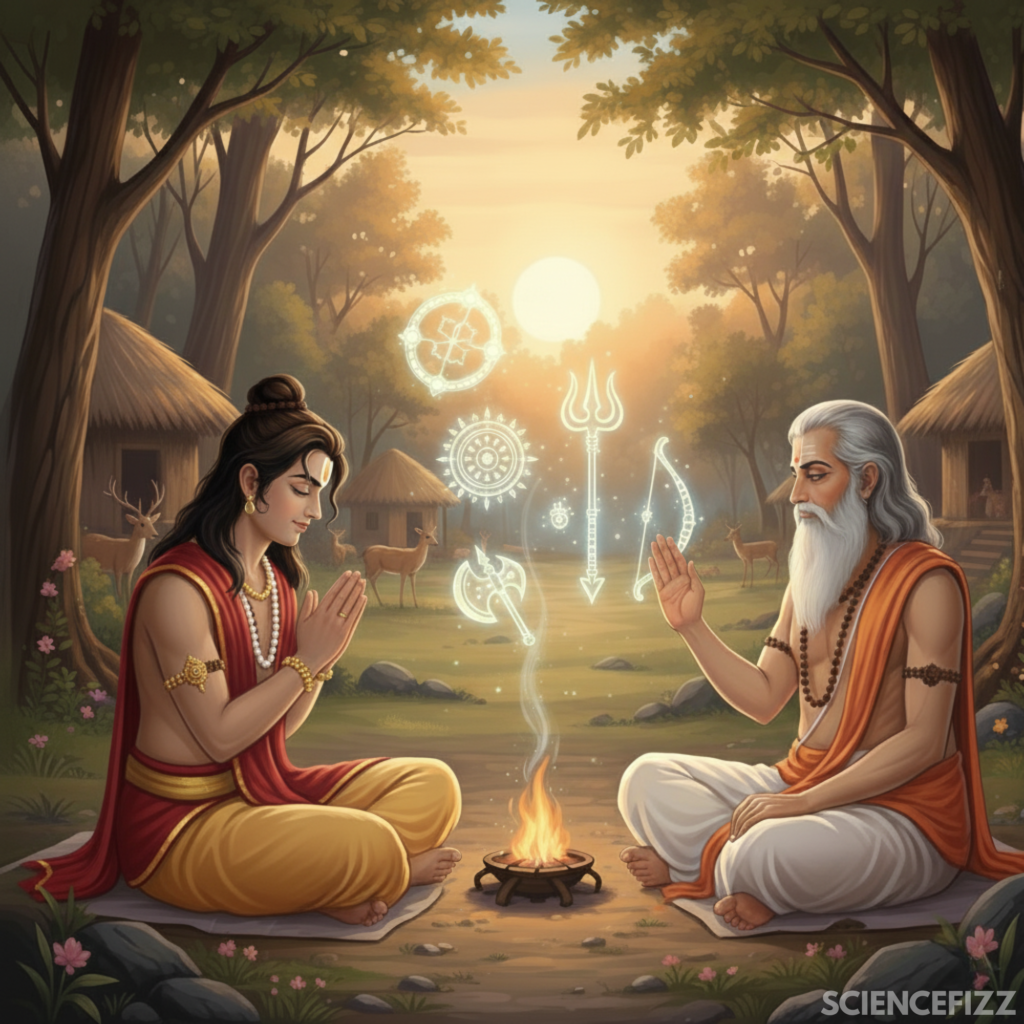
According to ancient tradition, Sage Vishwamitra was more than a spiritual guide; he was a ‘Scientist-Seer’ who possessed deep knowledge of advanced weaponry and cosmic energies. He served as a mentor to Prince Rama, a courageous and legendary warrior of the Ikshvaku dynasty.
Rama’s character was so exemplary—embodying justice, heroism, and morality—that in later centuries he came to be worshipped as a divine figure; Lord Rama – an avatar of the Cosmic Preserver, Vishnu, who descended to earth in human form for the welfare of humanity.”
Software-Hardware Integration (The Divyastras):
Vishwamitra initiated Prince Rama into the secrets of the Divyastras. These were not ordinary arrows but highly advanced, ‘command-based’ weapons.
The Return Mechanism: A striking feature of these weapons was their ability to return to the warrior after neutralizing the target.
The Programming:
In a modern scientific context, these can be viewed as the earliest conceptualization of AI-powered laser-guided missiles or Autonomous Drones. The ‘Mantras’ used to trigger them functioned like Programming Codes (Software) that provided specific instructions to the physical weapon (Hardware).
The Mahabharata Era: War-Engineering and Ethics
According to belief, Circa 5,000 years ago
By the time of the Mahabharata, human technical imagination had become even more complex, presenting sophisticated examples of ‘Intelligent Weapons.’
Narayanastra (Self-Adapting AI):
This weapon automatically changed its power and form based on the enemy’s response and numbers. It is an ancient metaphor for modern self-learning algorithms. Most importantly, it could distinguish between those who ‘surrendered’ and those who ‘challenged’ it—a profound lesson for today’s war engineers to develop Autonomous Weapons that can identify and protect innocent civilians.
Pashupatastra (The Invisible Software & Psychic Weapon):
Mythology describes Pashupatastra not as a physical weapon to be held, but as a vast energy linked to the warrior’s mental resolve and internal consciousness. This weapon was like a high-level ‘Invisible Software’ or ‘System Virus’ that directly neutralized the enemy’s combat capability.
Scientific Parallel:
Its nature differed from conventional weapons. It generated terrifying sounds and hallucinations, comparable to modern Infrasonic Weapons or Psychological Warfare. It paralyzed the enemy mentally and physically, much like how Biological Weapons operate invisibly today.
Brahmastra:
The Ancient Atom Bomb: The most terrifying weapon of this era was the Brahmastra, which can be considered the ancient blueprint of a Nuclear Weapon. Just as every powerful nation today seeks nuclear capability, every great warrior of that era aspired to possess the Brahmastra.
However, its destructive power was so immense that it was strictly reserved as a ‘Last Resort.’ Ancient texts suggest its use not only destroyed the enemy but also ended the possibility of life on that land for years, mirroring the effects of modern nuclear radiation.
The Oppenheimer Realisation – Power, Ethics, and the Encounter with ‘Mahakala’, The Eternal Destroyer
As we observe, scientific developments are double-edged swords; while they are fundamentally beneficial to human welfare, they can also pose an existential threat to humanity.
Whether it is the creation of mass-destruction weapons or the complex interference with nature through Genetic Engineering, the risks are as immense as the rewards. Therefore, the discourse on Scientific Ethics is becoming increasingly vital in our modern age.
But is scientific ethics a modern construct? Not at all. Even thousands of years ago, rigorous ethical frameworks were applied to scientific inventions. For instance, the use of the Brahmastra (the ancient Indian conceptualization of a nuclear-grade weapon) was governed by strict moral codes and was considered only as a last resort, a deterrent rather than a tool for casual warfare.”
These ancient Indian sagas describe more than just weapons; they outline a strict Code of Ethics. The ‘No First Use’ policy of modern nuclear-armed nations is an echo of these ancient ethical principles.

J. Robert Oppenheimer, the father of the modern Atomic Bomb, was deeply influenced by this philosophy. When he witnessed the world’s first nuclear test in 1945, the catastrophic sight reminded him of the message given by Lord Krishna to Arjuna in the Bhagavad Gita. He famously recalled the verse:
“Kalo’smi loka-kshaya-krit pravriddho…”
(I am become Death, the destroyer of worlds…)
Krishna told Arjuna that destiny had already decided the outcome, and Arjuna was merely a “Nimitta-matram” (an instrument).
Oppenheimer realized that while science had unleashed this power, its consequences must remain within the bounds of nature’s laws and human ethics.
Global Context: Ancient Robotics in Greece and China
Circa 3,000 years ago
While India researched advanced weaponry, other parts of the world dreamed of ‘Mechanical Humans.’
Talos (The Bronze Giant):
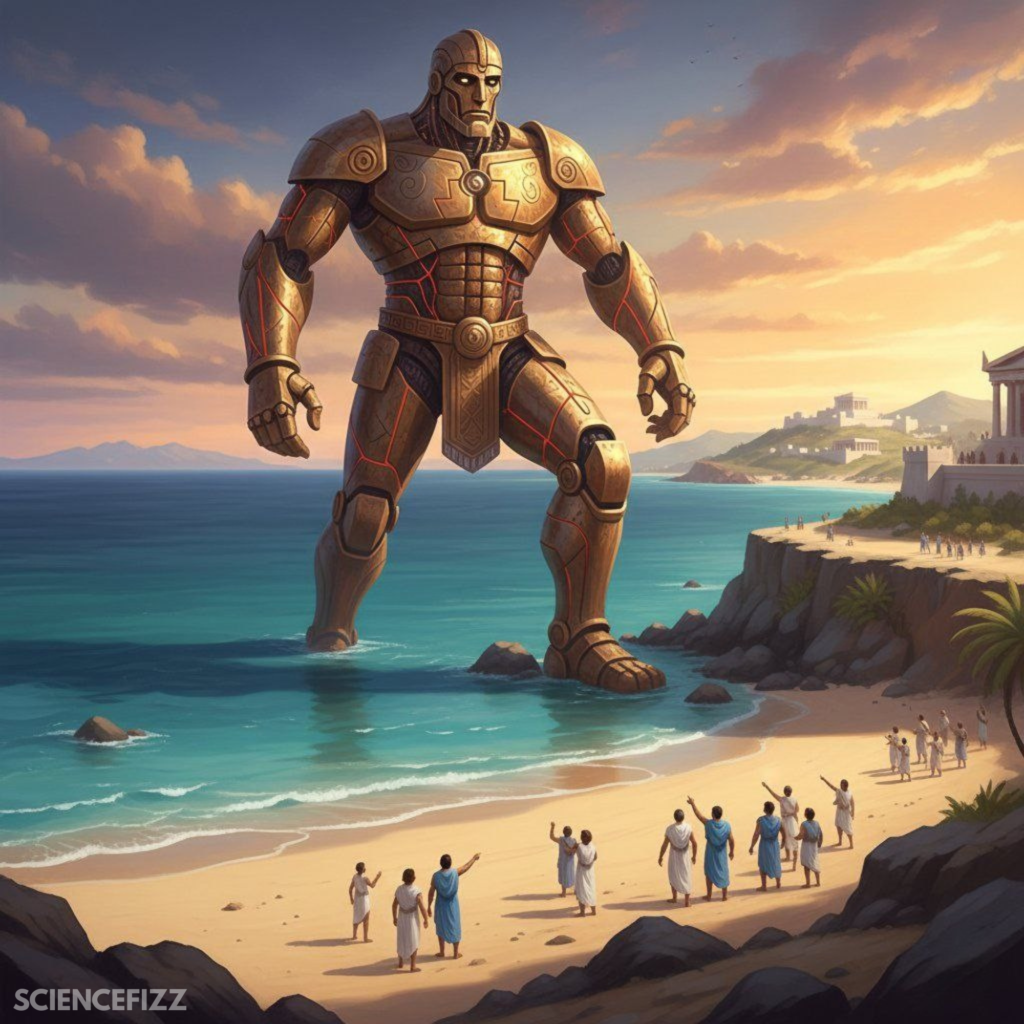
In Greek mythology, Talos is considered the oldest Conceptual Robot. A giant bronze man created by Hephaestus, it autonomously guarded the island of Crete.
Yan Shi’s Mechanical Man:
In ancient China, a craftsman named Yan Shi presented King Mu with a puppet that could walk and express emotions. When opened, it revealed artificial organs, proving that ancient humans were exploring the intersection of Mechanics and Anatomy.
The Middle Ages: The Transition from Myth to Historical Reality
12th to 13th Century
Up to this point, our journey has traversed the realms of the Ramayana, Mahabharata, and ancient Greek legends. While these accounts provide an extraordinary technical vision, they are rooted in cultural memory and mythological traditions.
However, as we move into the late 12th century, we cross a significant threshold—from the speculative to the evidentiary.
By the 12th century, the Arab-Islamic world had flourished into the global epicenter of scientific inquiry and cultural sophistication, bridging the wisdom of the ancients with the innovations of the future. This era marks the beginning of verifiable scientific records of automation and robotics.
Al-Jazari: Father of Robotics and the Architect of Modern Engineering
The central figure of this revolution was Badi’ al-Zaman al-Jazari, a brilliant polymath and engineer. His monumental work, The Book of Knowledge of Ingenious Mechanical Devices, serves as a living blueprint of medieval high-tech.
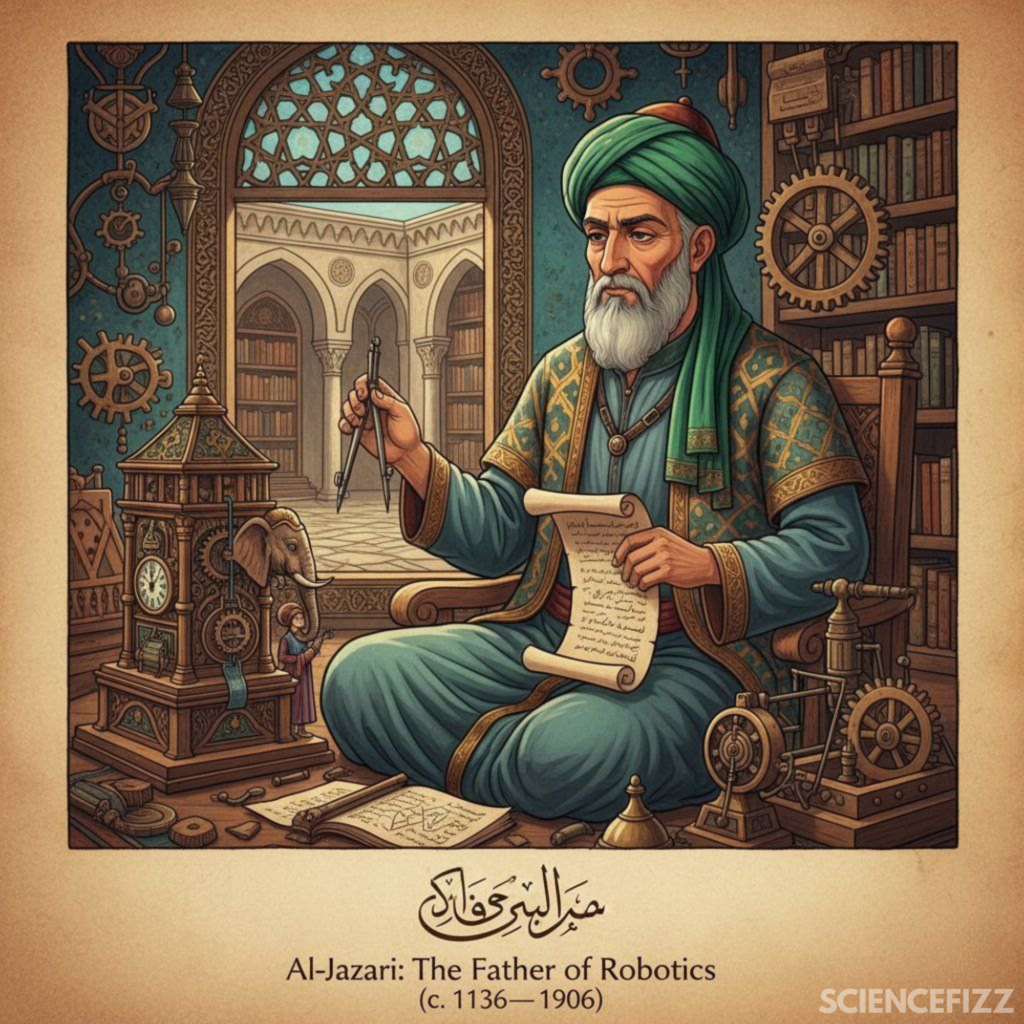
The importance of his work was brought to global light by the renowned historian of technology, Donald R. Hill, who translated Al-Jazari’s manuscripts. Hill emphasized the profound impact of these inventions on modern engineering, stating:
Donald R. Hill has conducted extensive research on the works of Al-Jazari and has recognized him as the “father of engineering.”
Al-Jazari’s Revolutionary Inventions:
Al-Jazari did not merely imagine; he engineered. His inventions laid the groundwork for modern mechanical intelligence:
The World’s First ‘Programmable’ Robot (The Musical Automata):
Al-Jazari designed a robotic musical band atop a boat. These mechanical musicians were powered by the flow of water, using a system of cams and levers to play drums and cymbals. Hill noted that the rhythm and timing could be altered by adjusting the water flow, making it an early ancestor of programming.
The Crankshaft:
The Heart of Modern Engines: Perhaps his most vital contribution to humanity was the crankshaft. By converting linear (straight) motion into rotary (turning) motion, he created a mechanism that remains the foundation of every car engine and robotic arm in the world today.
The Elephant Clock:
A Masterpiece of Robotics: This was a mechanical marvel that utilized hydraulics, weights, and automata. Every half hour, a series of mechanical dragons would tilt, a robotic bird would chirp, and a human figure would strike a gong. It was a spectacular display of autonomous behavior and precision timing.
Historical Significance:
Al-Jazari proved that machines could operate with a degree of independence. His work shifted the focus from static tools to dynamic, autonomous systems, forming the true DNA of modern Robotics and Mechanical Engineering.
Science vs Religious Conservatism: The Echoes of a Great Rebellion
While the sparks of genius were lit across the globe, from Aryabhata, Charaka, and Sushruta in India to the pioneering mathematicians of the Islamic Golden Age, the astronomical observers of Ancient Greece, and the early innovators of China, the torch of a systematic scientific revolution eventually found its home in the European Renaissance.
As the Middle Ages were drawing to a close, a new wave of rational thought was rising in Europe. But the path was fraught with challenges. The Church held immense power, and scientists were permitted to speak only as long as their discoveries did not contradict religious dogma. In such a repressive environment, challenging established beliefs was often tantamount to inviting death.
At the end of this dark period, a man emerged who dared to envision the human body as a ‘complex machine’. He was a painter, an architect, and a mysterious genius who, in his secret notebooks, had sketched blueprints for tanks, flying machines, and robots five centuries ago.
Who was this man who defied the orthodox Church and ignited the flame of modern science? How did he encode the secrets of engineering within his art?
Leonardo da Vinci: Master Artist, Anatomist, War Engineer, and the Architect of Mechanical Intelligence.
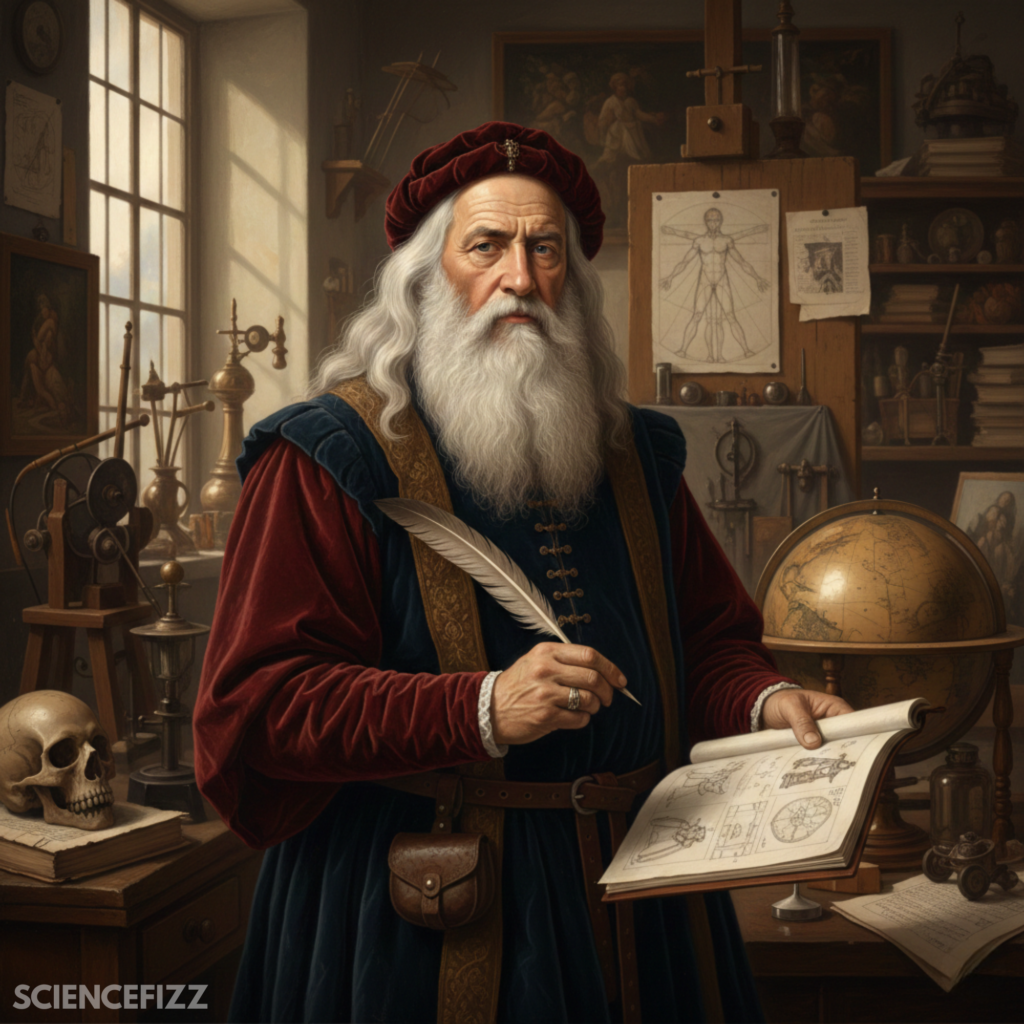
Imagine a moonlit night in 15th-century Italy. While the world sleeps, a man sits in a cold room, meticulously dissecting a human cadaver. He isn’t looking for a soul; he is looking for mechanisms.
To the world, he is the creator of the Mona Lisa, but in his mind, he is a War Engineer and a Visionary Anatomist trying to solve a 500-year-old puzzle: Can we recreate the miracle of life using gears and pulleys?
We will know more about Leonardo da Vinci, the versatile personality, in the next article.